Meet Baseline.
An AI tennis coach that watches every shot in your phone video, scores your game on one scale, and tells you the one thing to fix first.
1 analysis a month free. No card needed.
The problem
You can’t watch every shot.
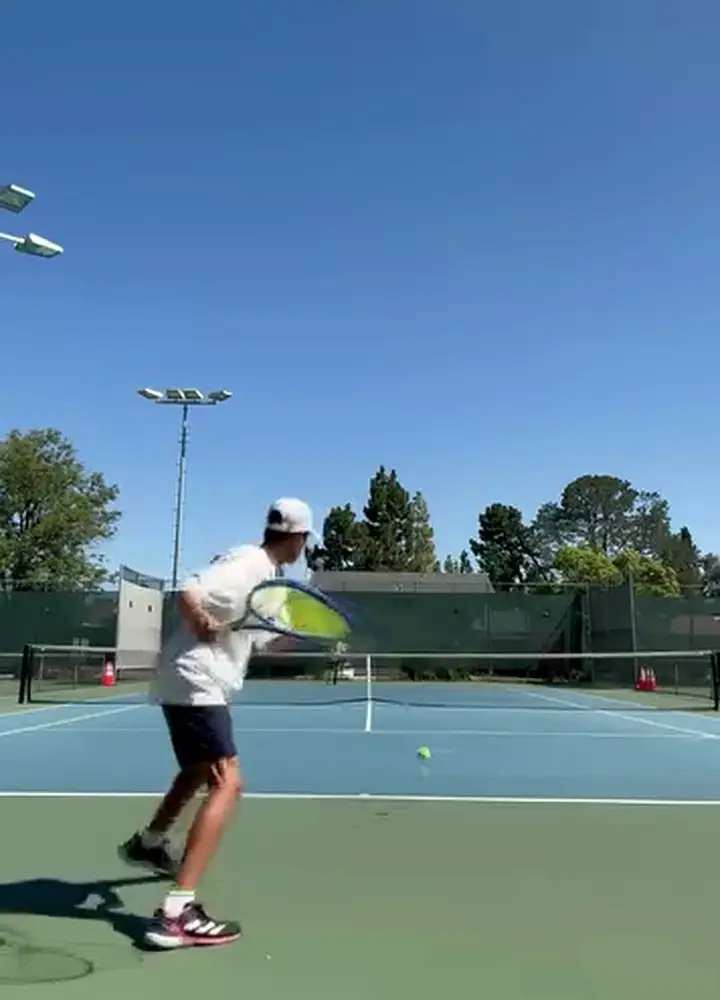
Two minutes of practice is 27 shots. You can film all of them and watch them back, and the one that keeps going wrong still looks like the rest at full speed.
Every shot Baseline logged in one real 2:16 practice clip.
This is Baseline
One video in.
A coach’s read out.
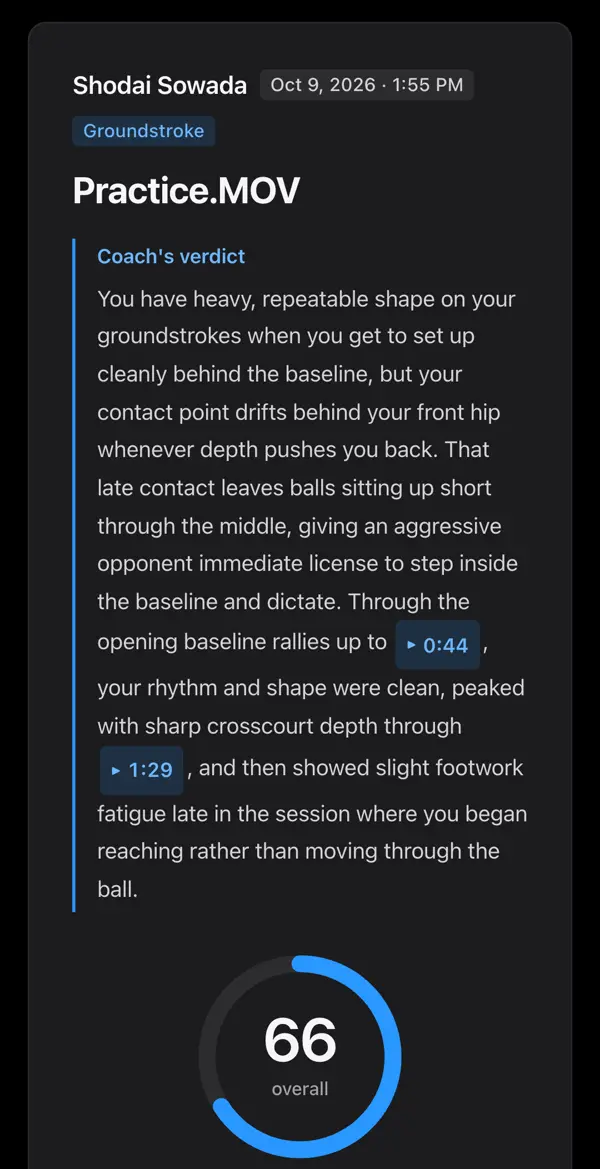
Practice.MOV
Coach’s verdict
You have heavy, repeatable shape on your groundstrokes when you get to set up cleanly behind the baseline, but your contact point drifts behind your front hip whenever depth pushes you back.
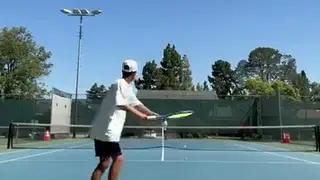
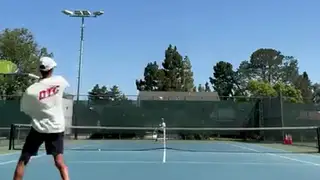
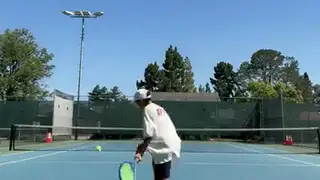
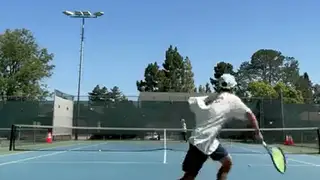
Baseline’s real report on a real practice clip, unedited.
01Shot timeline
Every shot, on the clock.
Baseline logs each shot it sees with its time. Click one and the film jumps there, with slow motion and frame stepping built in. If a label is wrong, fix it, and your correction is kept with the report.
02Scores
Scored on one scale.
Technique, movement and consistency, each out of 100, on one universal scale anchored to UTR levels. Your score is a real level, not a grade on a curve.
03Fix this first
The one thing to fix first.
Not a list of fifty faults. The change that will help most, lifted to the top of the report, with the drill for it and why it works.
Fix this first
Late contact point on deep forehands
- Drill
- 4x15 reps of live-ball crosscourt forehands with a target cone placed two feet in front of your left toe that you must catch the ball over
- Why
- it trains your eyes and shoulder turn to meet the ball out in front before it pushes your hands back.
04Notes on your film
Tap a note. See the moment.
Every time in the report is a real shot from your video. Timestamps that don’t match a logged shot are removed before you ever see them.
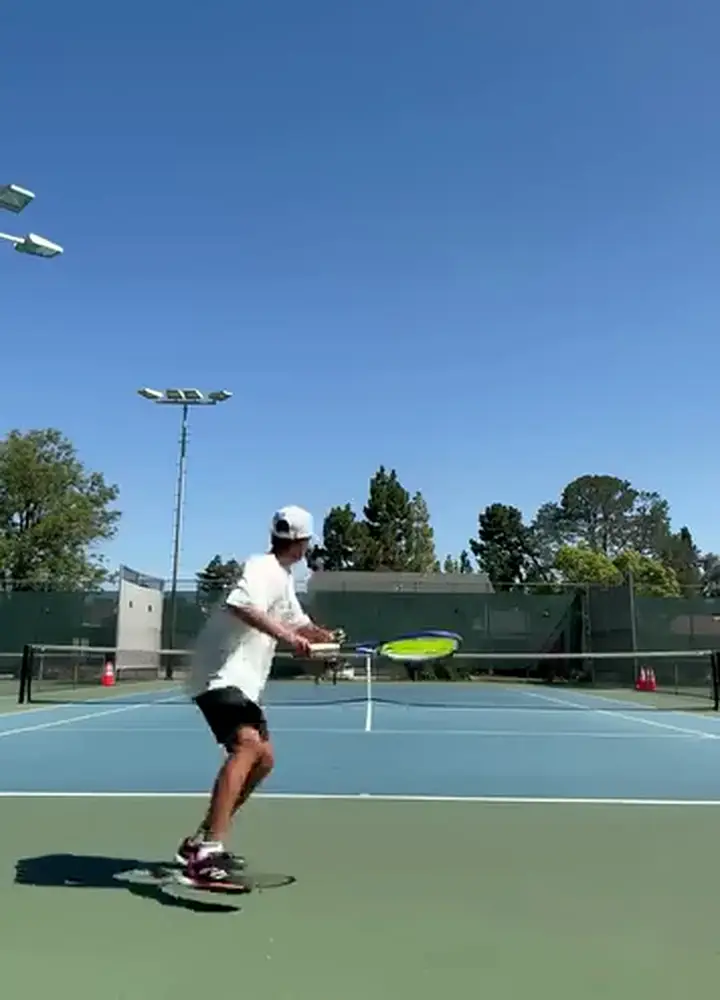
Technique · 67
When pushed wide on the forehand at , your contact point drops behind your left hip, which sprays the ball long or leaves it floating.
Try it: tap 0:25.
05Ask Coach
Ask why.
Follow-up questions are answered from that session’s report, and the answer points to moments in your video. This answer is real, unedited. Starter includes 2 questions a month.
Ask Coach
Why do my deep balls keep landing short?
When you get pushed back by depth, your contact point drifts behind your lead hip instead of staying out in front. Striking late bleeds off your penetration and leaves the ball sitting up short through the middle of the court. Two things drive this in your session: 1. On deep forehands, your takeback gets high and disconnected from your hip turn. When you rush your setup—like at 0:44—you arm the ball from behind your body instead of driving through it. 2. On high bouncing backhands, you get forced above shoulder level. At 0:22, striking that high forced an awkward arm swing that killed your pace and landed short. To keep your ball deep when pushed, give yourself space early. Take an aggressive drop step so you can let high balls drop into your waist-level strike zone, and focus on meeting the ball two feet in front of your lead hip.
- How do I fix my high takeback on deep balls?
- Should I take high backhands on the rise instead?
- What drill will keep my contact point out front?
06Practice plan
Then, the week’s work.
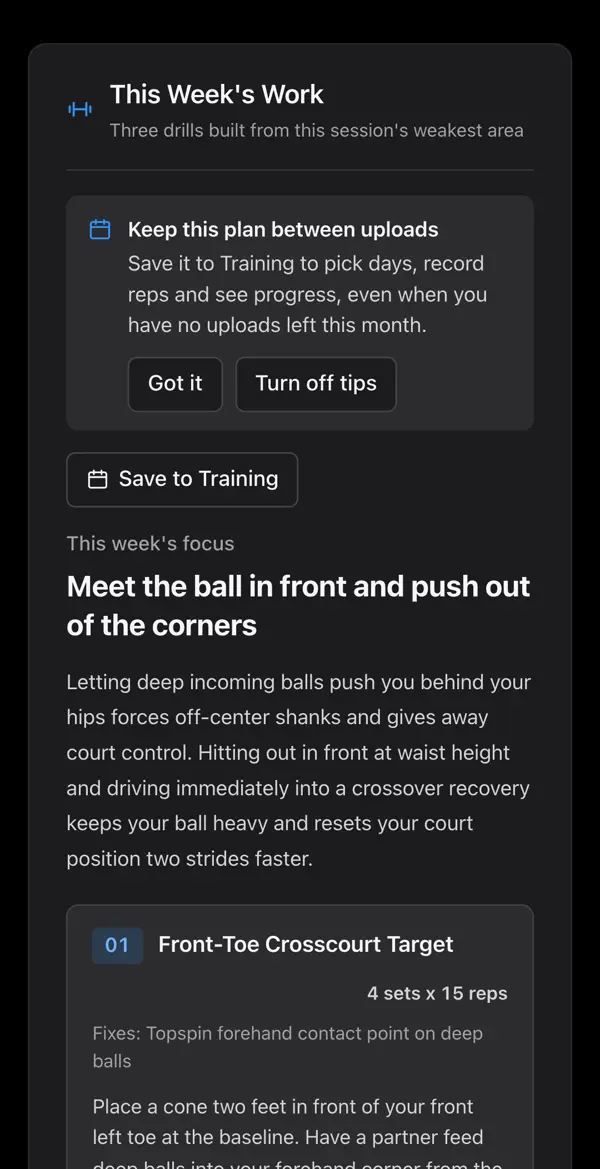
Three drills built from the session’s weakest area, each with a dose and a clear “done when”. Every plan includes it, free too.
This Week’s Work
01Front-Toe Crosscourt Target
4 sets × 15 reps
At least 12 out of 15 balls land past the opposing service line with clean center-string contact and no shanks off the frame.
07Progress
Watch the number move.
Each player’s scores session by session, their level, and the distance to the next one. Two sessions are enough to show a trend. Compare any two side by side, and set a score to chase.
Overall scoreSample data
How it works
From phone to plan in four steps.
Every shot, watched.
1 analysis a month free, no card needed. Paid plans from $15 a month.
The report, shot timeline, verdict, Ask Coach answer and practice plan on this page are Baseline’s real output for one real practice clip. The progress chart shows sample data.